The science
Vibrational fingerprints, measured at room temperature
QES takes a laboratory physics technique out of the cryostat and puts it on the bench, in water, at biological concentrations.
Origins
A practical evolution of Inelastic Electron Tunneling Spectroscopy
IETS measures the vibrational frequencies excited by a molecule's tunnelling electrons and uses them as a chemical fingerprint. It is exquisitely informative: every bond in every molecule carries a characteristic signature, and no label, probe or affinity reagent is needed to see it.
Historically, IETS demanded ultra-low temperatures. Thermal broadening at ambient conditions swamped the inelastic features, confining the technique to cryogenic physics laboratories and to samples nothing like a drop of blood.
QES removes that limitation. An engineered electrochemical interface, a tailored excitation regime and a computational recovery pipeline together resolve the same vibrational information at room temperature in aqueous biological media — turning a specialist physics measurement into a routine bioanalytical one.
Diagram
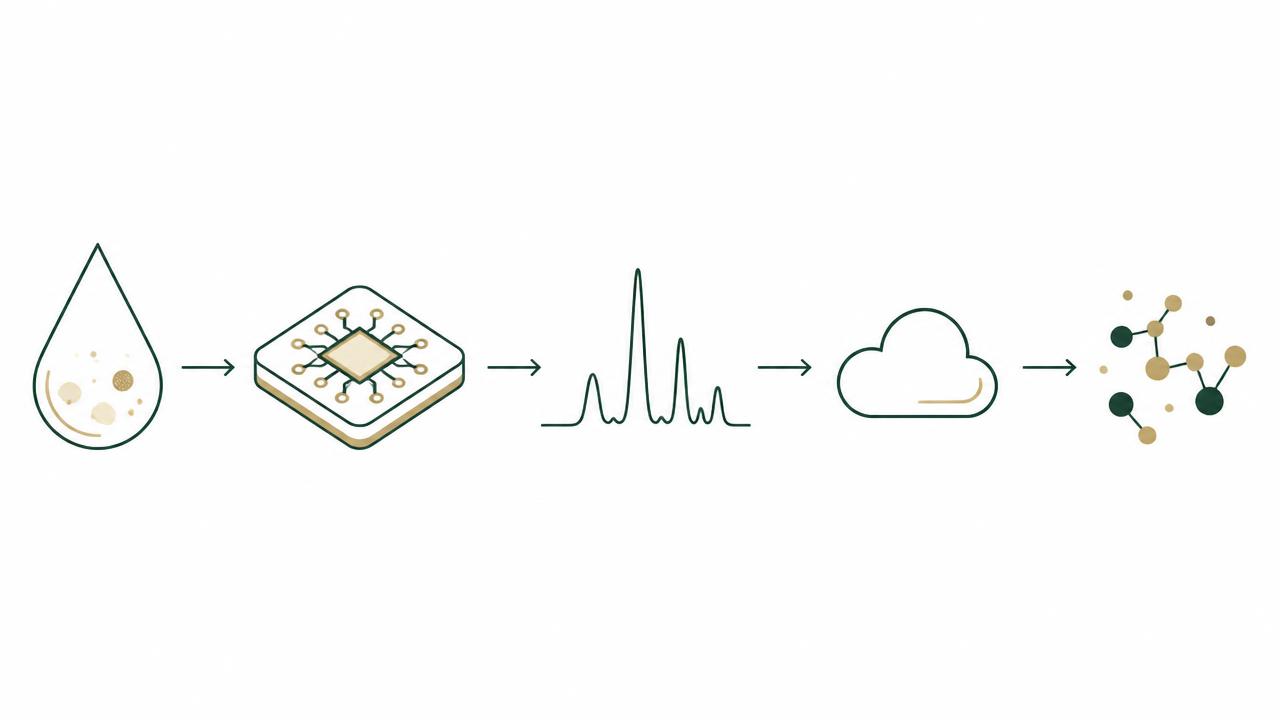
From specimen to digital twin
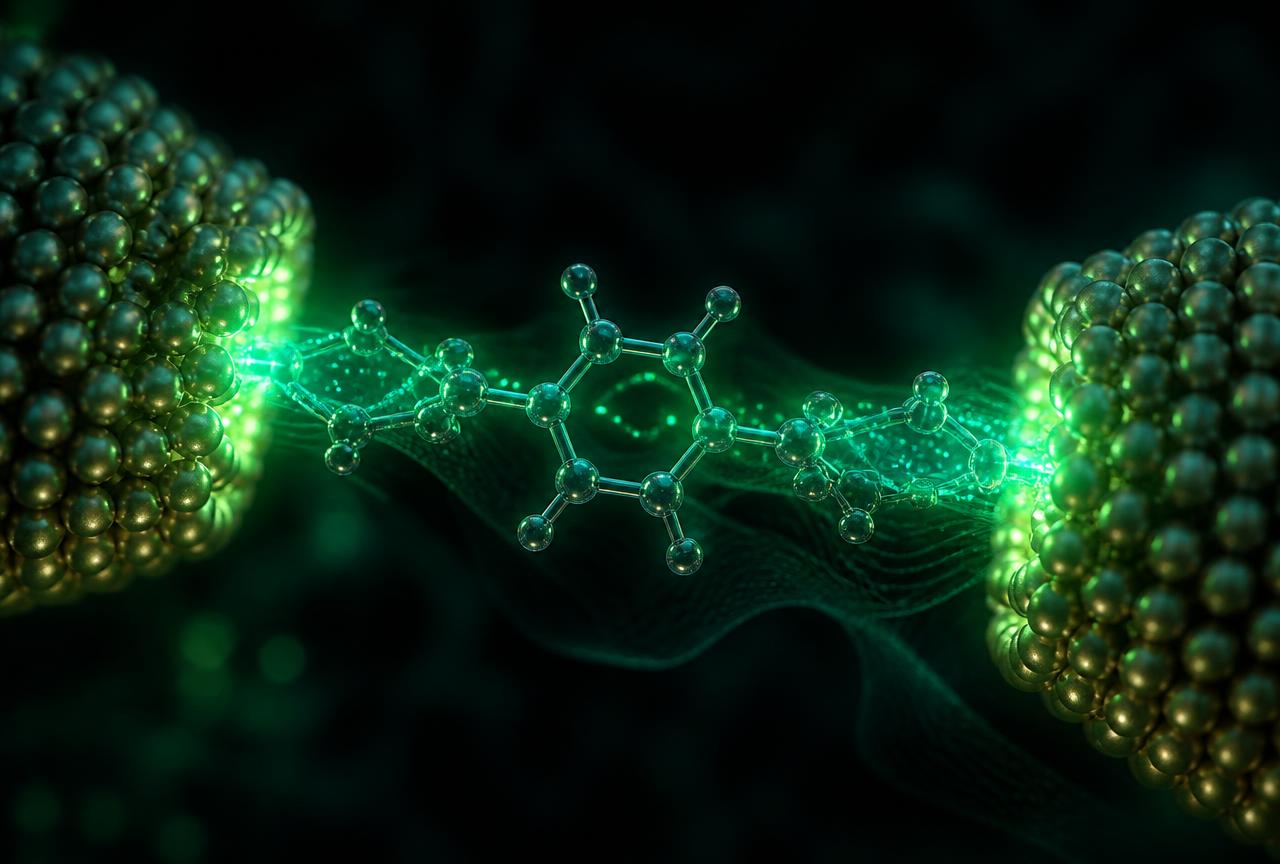
Electron charge transfer at the quantum level
At the sensing interface, electrons transfer between the electrode and the molecular environment of the sample. A small, well-defined fraction of those electrons lose a quantum of energy to a vibrational mode of a nearby bond. Sweeping the excitation and measuring where those inelastic losses occur reconstructs a vibrational spectrum of everything present — proteins, metabolites, nucleic acids, drugs and whole cells alike.
Signal-to-file pipeline
The instrument digitizes the response at high resolution and packages it with acquisition parameters, environmental telemetry and sample provenance into a single immutable file. Nothing about the file is analyte-specific: it is a complete physical record of the specimen's biochemistry at the moment of measurement.
Cloud processing
In the cloud, conditioning and baseline correction are applied, the vibrational ensemble is deconvolved, and physics-informed models infer concentrations for the requested analytes with per-result quality metrics. Because processing is decoupled from acquisition, model improvements propagate retroactively to every historical file.
AI-ready datasets
Each measurement becomes a standardized high-dimensional vector with consistent metadata. Datasets from different sites, cohorts and species federate without harmonization work, which is precisely the format machine-learning teams need and conventional instrumentation rarely provides.
Licensed technology
Regional deployment of a proven platform
Quantabia is built on licensed Probius technology and adapts it for Saudi and GCC research, clinical and bioproduction settings — including local scientific support, training and data residency.
FAQ